Heartburn Medicine in Japan: 3 PPIs and Gaster 10 Compared
Japan now sells omeprazole, rabeprazole, lansoprazole, and famotidine without a prescription. Here's how the four acid reducers differ, who shouldn't take them, and how to buy them.
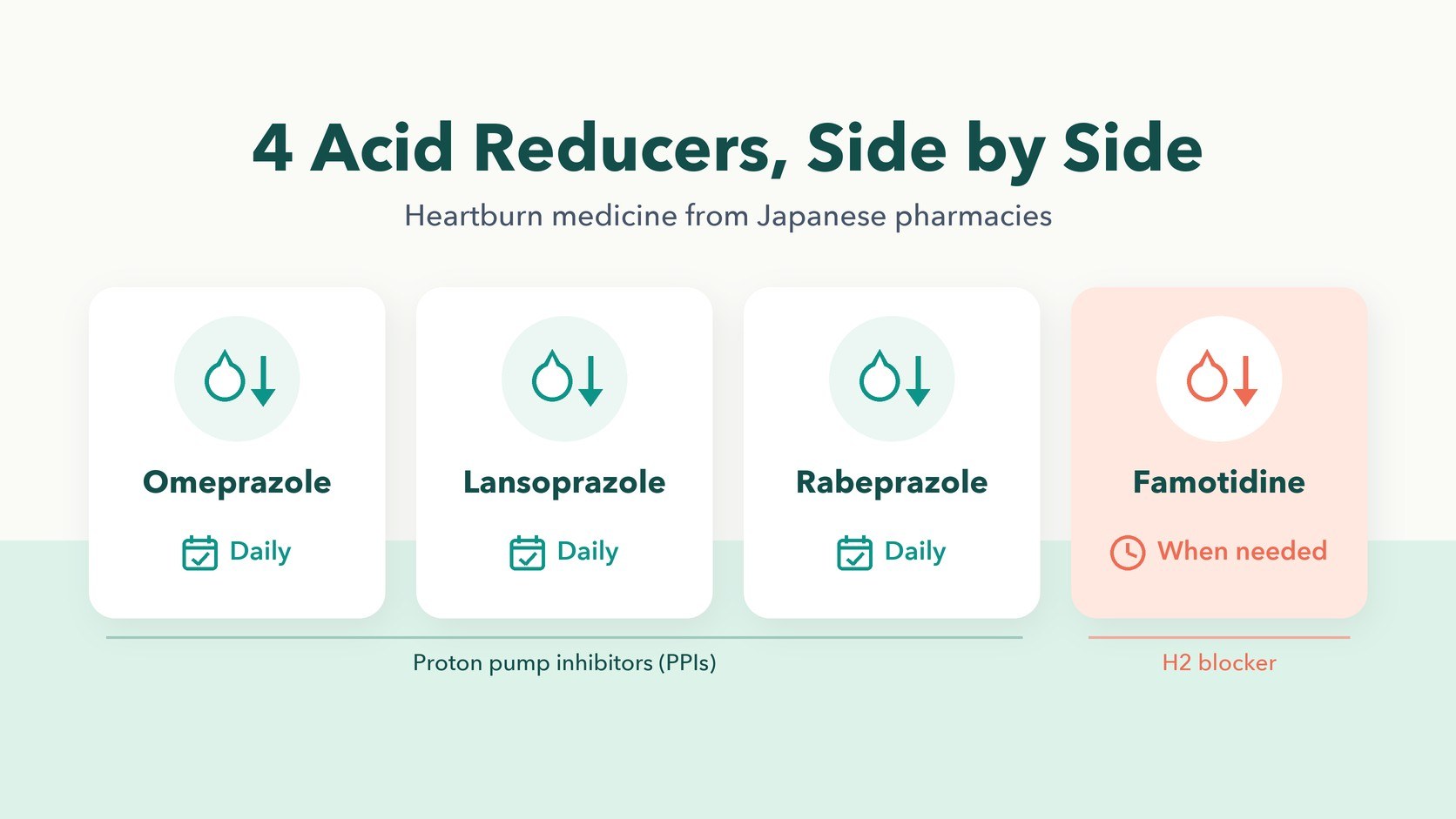
That burning feeling behind your chest after a big dinner, or acid creeping up your throat at night. If you're looking for heartburn or acid reflux medicine in Japan, the drugstore now has four acid reducers you may know from home, sold without a prescription: three proton pump inhibitors (PPIs) and the H2 blocker famotidine.
They are not shelf items you pick up yourself. All four are sold by a pharmacist. This page compares them using their Japanese package inserts, which OTC Guide Japan has translated into English.
Quick summary
- PPIs (Omepral S, Pariet S, Takepron s): 1 tablet once a day, at the same time of day, for ages 15 and up.
- Gaster 10 S Tablets (famotidine): 1 tablet when symptoms appear, up to 2 a day, for ages 15 to 79.
- Do not take any of them with other stomach medicines, so don't combine a PPI with Gaster 10.
- No better after 3 days? Stop and talk to a doctor or pharmacist. Never take them for more than 2 weeks in a row.
PPI vs H2 Blocker: The Four at a Glance
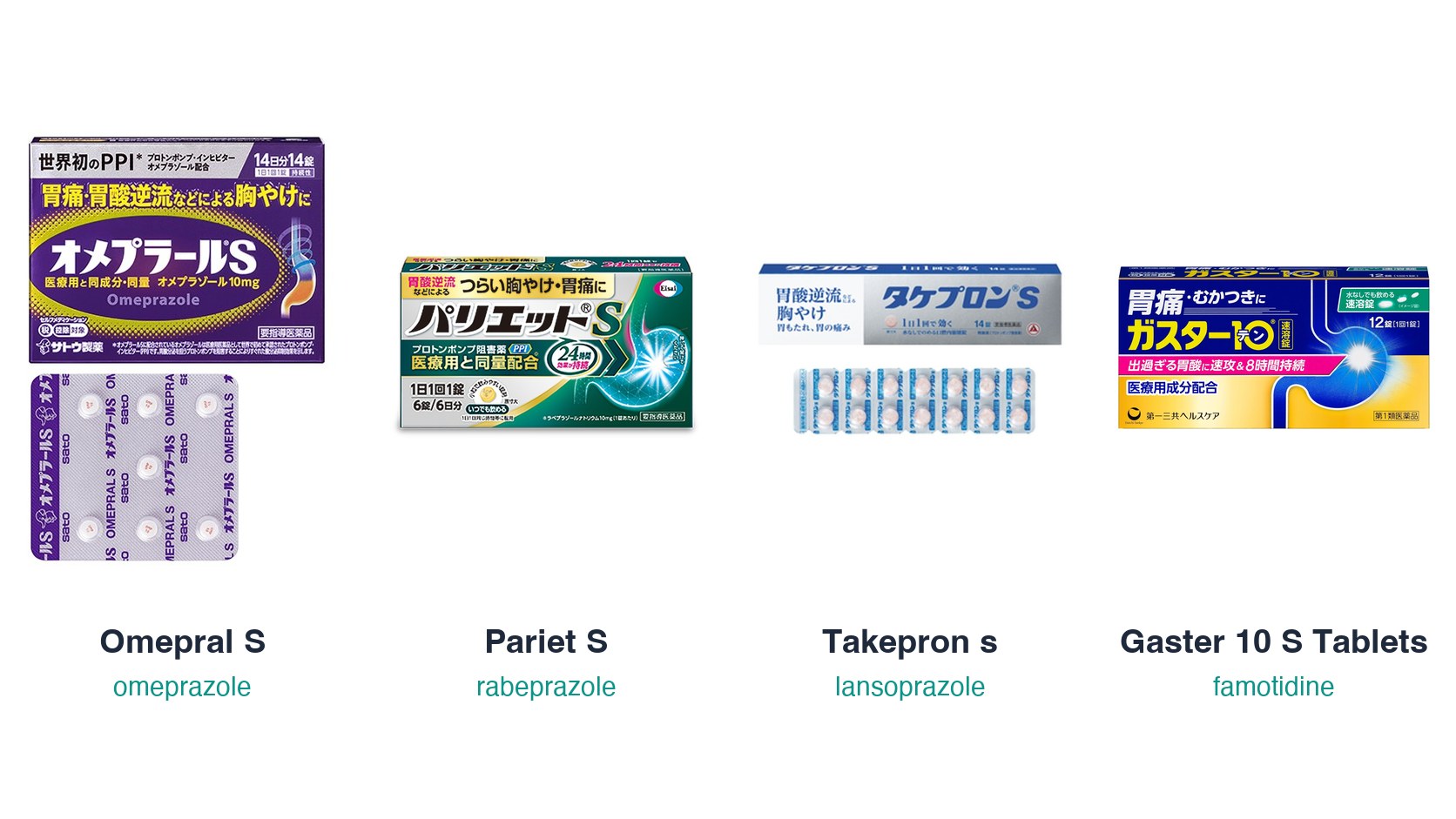
| Product | Ingredient | How to take | Ages | Class |
|---|---|---|---|---|
| Omepral S オメプラールS | Omeprazole 10 mg (PPI) | 1 tablet once a day, same time of day. Swallow whole; don't chew or crush. | 15+ | Pharmacist-Guidance |
| Pariet S パリエットS | Rabeprazole sodium 10 mg (PPI) | 1 tablet once a day, same time of day, with water or lukewarm water. Don't chew or crush. | 15+ | Pharmacist-Guidance |
| Takepron s タケプロンs | Lansoprazole 15 mg (PPI) | 1 tablet once a day, same time of day. Dissolves in your mouth, or take with water. | 15+ | Pharmacist-Guidance |
| Gaster 10 S Tablets ガスター10 S錠 | Famotidine 10 mg (H2 blocker) | 1 tablet when symptoms appear, up to 2 a day, at least 8 hours apart. Dissolves in your mouth, or take with water. | 15 to 79 | Class 1 |
The PPIs are approved for stomach pain, heartburn, and a heavy stomach feeling. Gaster 10 is approved for stomach pain, a heavy stomach feeling, heartburn, and queasiness.
Prilosec, Prevacid, Aciphex, or Pepcid Equivalent in Japan
If you use one of these at home, look for the same ingredient on the Japanese box:
- Omeprazole (the ingredient in Prilosec): Omepral S
- Lansoprazole (the ingredient in Prevacid): Takepron s
- Rabeprazole (the ingredient in Aciphex): Pariet S
- Famotidine (the ingredient in Pepcid AC): Gaster 10 S Tablets
The amount per tablet and the directions can differ from the product you know, so follow the Japanese package insert, not your home label.
Every Day or When You Need It?
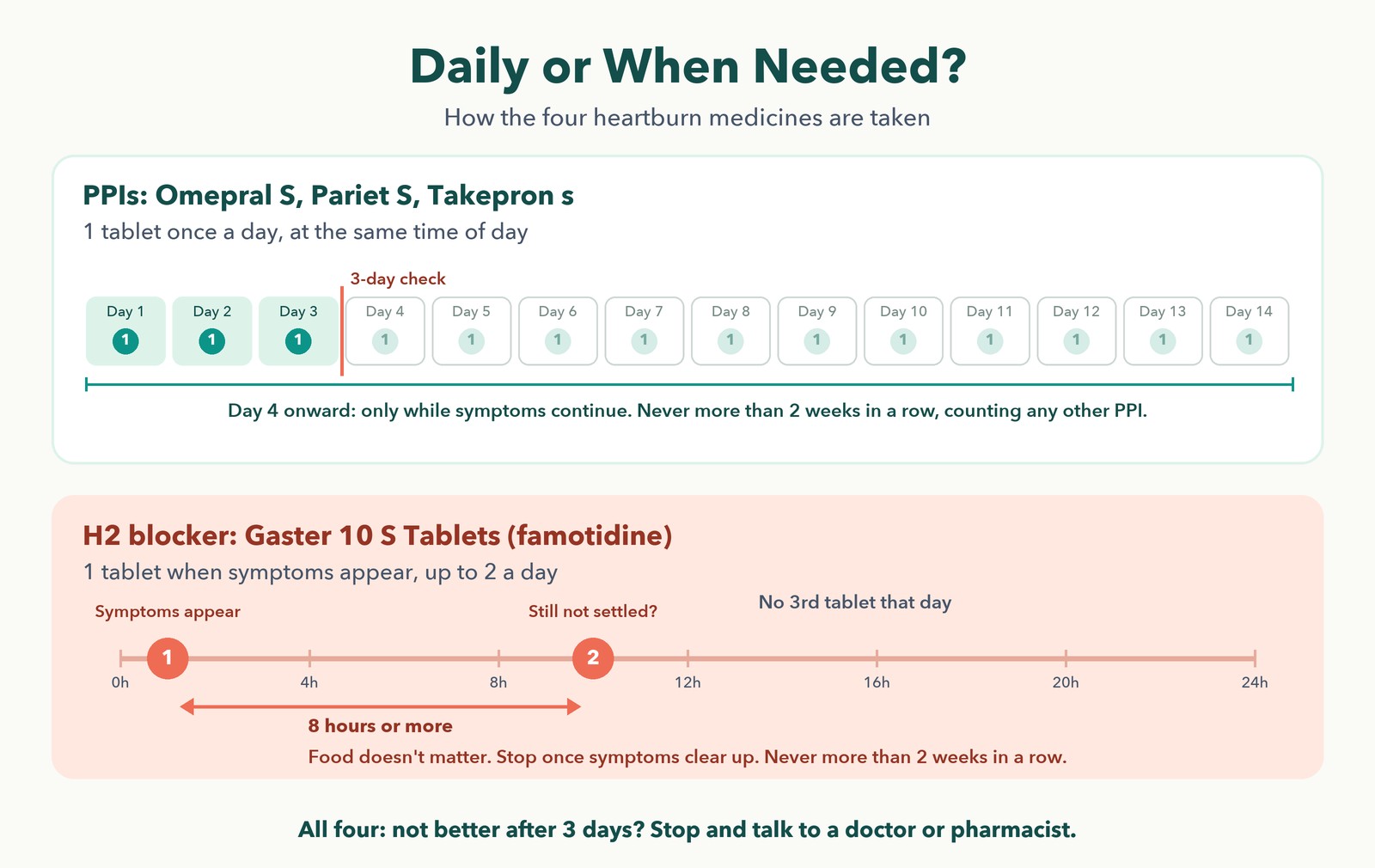
The three PPIs are taken once a day at the same time of day. Stop once your symptoms clear up, and don't take them for more than 2 weeks in a row, counting any other PPI you've taken.
Gaster 10 works differently. Its package insert says it isn't taken at set times but when symptoms appear, and food doesn't affect it, so you can take it before, after, or between meals. One tablet controls excess stomach acid for about 8 hours. If symptoms haven't settled 8 hours or more after the first tablet, you can take one more, up to 2 a day.
What to Expect After You Take It
- Pariet S: the maker says its effect on stomach acid has been confirmed from 1 hour after taking it, but it varies from person to person, so judge it after taking it once a day for 3 days. You can take the first tablet when symptoms start, before or after a meal; after that, take it at the same time each day.
- Omepral S and Takepron s: the makers say one tablet a day works for 24 hours.
- Gaster 10: one tablet controls excess stomach acid for about 8 hours.
- Feeling better? Stop taking it.
- Not better after 3 days? Stop and talk to a doctor or pharmacist, bringing the package insert.
Side effects listed in the package inserts include diarrhea, constipation, and dry mouth. Stop right away and talk to a doctor or pharmacist if you get a rash or itching, or any of the other side effects listed on each product page. Rare but serious reactions, such as anaphylaxis, need medical help immediately.
Rules That Apply to All Four
- No other stomach medicines while you take any of them. That includes taking a PPI and Gaster 10 together.
- 3 days: if your symptoms don't improve, stop and talk to a doctor or pharmacist, bringing the package insert.
- 2 weeks: don't take them for longer than this in a row. The package inserts warn that a serious digestive disease could be missed, so see a doctor.
- Breastfeeding: don't take them, or avoid breastfeeding if you do.
- Under 15: not for children.
Who Shouldn't Take Them
Each product has its own list. A few points that differ:
- All three PPIs: not for people taking rilpivirine hydrochloride (an HIV medicine).
- Takepron s: also not with oral medicines containing theophylline (some cough and motion sickness medicines) or magnesium oxide (some laxatives). Talk to a doctor or pharmacist first if you have phenylketonuria.
- Gaster 10: not for people being treated for a blood, kidney, liver, heart, stomach or duodenal, or immune system disease (such as asthma or rheumatism), or being given steroids, antibiotics, anticancer drugs, or azole antifungals at a medical institution. Also not for people with phenylketonuria, people who are pregnant or might be, or people 80 or older.
- Pregnancy and the PPIs: talk to a doctor or pharmacist before use.
The makers' check sheets for Omepral S and Pariet S also list other medicines to mention to the pharmacist, such as warfarin, digoxin, and methotrexate. The full lists are on each product page.
When to See a Doctor Instead
The package inserts ask you to talk to a doctor or pharmacist before use if you have:
- Weight loss you can't explain
- Stomach or abdominal pain that won't go away
- For Gaster 10: a sore throat, cough, and high fever together
Also check with them if you're already under a doctor's care, are elderly, or have been diagnosed with liver disease or a stomach or duodenal ulcer (PPIs).
How to Buy Heartburn Medicine in Japan
- PPIs are Pharmacist-Guidance Drugs (要指導医薬品). Go when a pharmacist is on duty. You'll go through a check sheet together before they sell it.
- Gaster 10 is a Class 1 medicine (第1類医薬品), also sold by a pharmacist, who will explain it before you buy.
- Check sheets: you can prepare before you go. Pariet S and Takepron s have printable check sheets (linked on each product page), and Omepral S has an online self-check you can show the pharmacist.
- Bring a list of your medicines, or your お薬手帳 (medication notebook) if you have one. Several of these products can't be taken with certain medicines.
- Gaster 10 is also sold on Amazon Japan.
- Not sure which one fits? Tell the pharmacist your symptoms and any medicines you take. They can help you decide.
If your Japanese is limited
「胸やけの薬はありますか?」
Muneyake no kusuri wa arimasu ka?
"Do you have medicine for heartburn?" Read it out, or just show this Japanese text on your phone.
Full Warnings in English
OTC Guide Japan has translated each package insert into English, including side effects and the rare serious symptoms to watch for:
Sources & Documents
- Japanese package inserts: Omepral S, Pariet S, Takepron s, Gaster 10 S Tablets
- Makers' information: Pariet S FAQ (how soon it works), Omepral S product page
- Same ingredients abroad: Prilosec OTC (DailyMed), Prevacid 24HR (DailyMed), Aciphex (FDA), Pepcid AC (Health Canada)
This page summarizes the Japanese package inserts and the makers' check sheets for these four products (October 2026). OTC Guide Japan translated and explained them in English. It is for information only and doesn't replace advice from a doctor or pharmacist. Always read the package insert that comes with the medicine.